Piñones para empacadoras
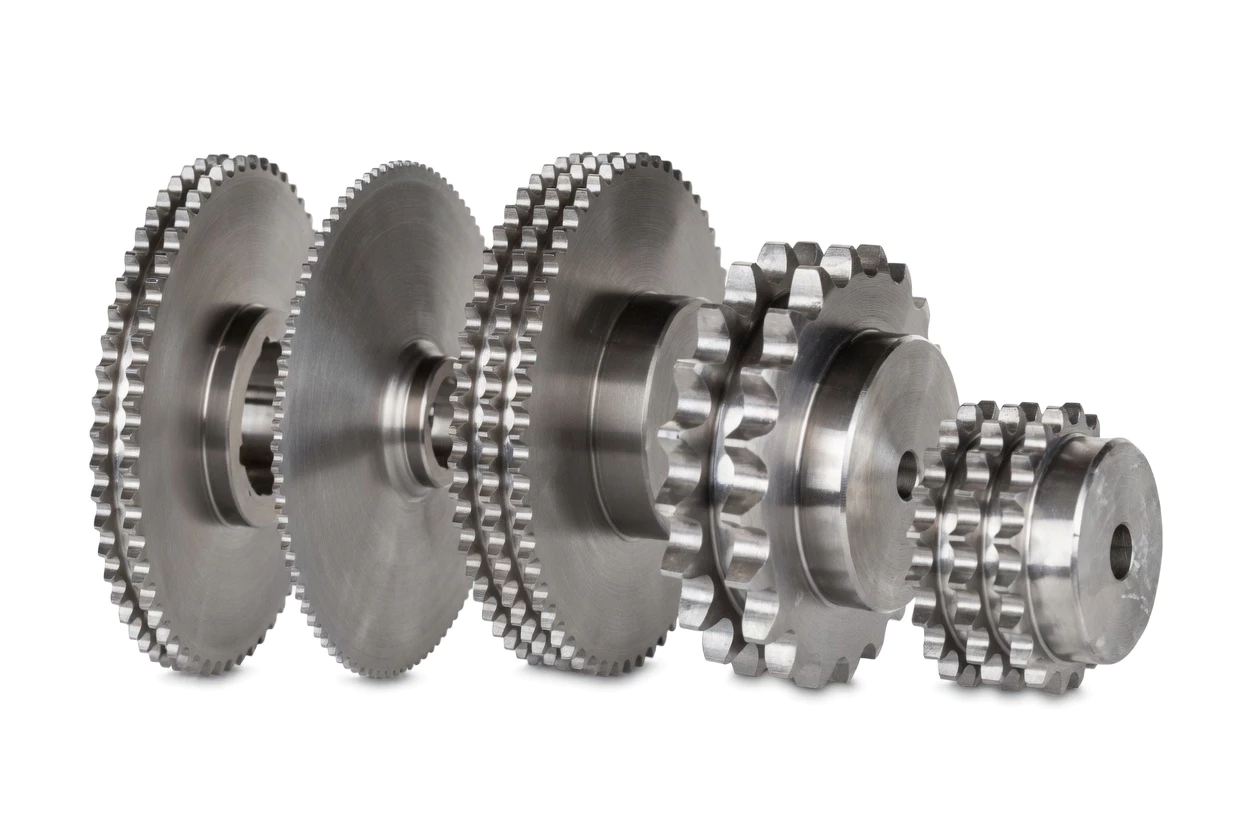
Hay and straw balers — round balers, large square balers (LSB), and small square balers — rely on dozens of chain drives to feed, form, tie, and eject bales. Baler chain sprockets are subjected to one of the most severe duty cycles in agricultural machinery: repeated shock loading from crop pick-up and plunger impact, abrasive chaff and dust, and continuous operation across long baling days. A failed baler sprocket in the field costs valuable baling-weather time. Browse our agricultural sprockets →

Descripción general
A modern large square baler (LSB) may contain 20–40 individual chain drive positions covering pick-up, pre-cutter, feeder, packer, plunger drive, bale measurement, knotters, and bale ejector functions. Round balers use 10–20 chain drives for the pick-up, rotor, belt drive, bale chamber chain, and wrapping system. All of these operate in a dusty, chaff-laden environment with intermittent heavy shock loading. The most demanding positions — plunger drive, feeder chain, and knotter crank chain — require the highest quality induction-hardened sprockets to survive a full baling season.
Especificaciones técnicas
| Parámetro | Baler Value | Rango |
|---|---|---|
| Chain Standard (pick-up/feeder) | ANSI #50 / #60 | ANSI #40–#80 |
| Chain Standard (plunger drive) | ANSI #80 / #100 | ANSI #60–#120 |
| Pitch | 15.875–25.4 mm | 12.7–38.1 mm |
| Tooth Count (driver) | 13T – 21T | 9T – 30T |
| Material (standard) | C45 induction-hardened | 40Cr alloy for plunger drive |
| Dureza dental | HRC 50–60 | HRC 48–62 |
| Profundidad del caso | 1.5–2.5 mm | Up to 3.5 mm |
| Clasificación de carga de choque | High (plunger cycle) | Very high for plunger drive sprocket |
| Estilo Hub | orificio acabado tipo B | Taper-bushed on plunger and feeder main drives |
| Tolerancia del orificio | H7 | H6 for critical alignment positions |
| Superficie | Óxido negro / zinc | — |
| Hebra | Simplex | Duplex on high-power plunger drives (LSB) |
| Lubricación | Manual spray or drip | Per OEM service interval |
| Entorno operativo | Dusty, chaff, moisture | Sealed-hub on request for LSB |
| Grado de mecanizado | Grado DIN 6 | — |
| Thermal Deformation | ≤0,05 mm | — |
| Seasonal Life Expectation | 1–3 seasons depending on position | — |
| Documentación | Certificado de lote a petición | — |
| Weight (ANSI #50 Z=17) | ~0.8 kg | 0.2–12 kg |
Performance Advantages
Información de compatibilidad
| Baler Position / Chain | Piñón recomendado | Notas |
|---|---|---|
| Round baler pick-up drive (ANSI #50) | ANSI #50 C45 induction-hardened sprocket | High shock from crop ingestion |
| Round baler rotor chain (ANSI #60) | Piñón ANSI #60 | Check OEM tooth count carefully |
| LSB feeder chain (ANSI #60) | Piñón ANSI #60 | High cyclic load, replace pre-season |
| LSB plunger drive chain (ANSI #80 / #100) | ANSI #80 / #100 heavy-duty sprocket | 40Cr alloy steel preferred |
| LSB knotter chain (ANSI #40 / #50) | ANSI #40 / #50 precision sprocket | Grade 6 for knotter timing |
| Small square baler plunger (ANSI #50) | ANSI #50 heavy-duty sprocket | Shock load tolerant |
| John Deere, New Holland, Kuhn balers (ref only) | Intercambiables según ANSI #40–#100 | Verify tooth count per baler service manual |
| CLAAS, Krone, Massey Ferguson (ref only) | ISO 10B–20B o equivalente ANSI | Confirm chain standard (ISO vs ANSI) |
Selection Guide for Baler Sprockets
| 📑 | Service Manual First | The baler service manual is the authoritative reference for every chain drive position: chain part number, pitch, tooth count, bore, and replacement interval. Always start here — baler chain drives are interconnected, and incorrect tooth count on one drive can cause timing and feed rate errors. |
| 🔎 | Inspect All Positions Pre-Season | Inspect every chain drive sprocket before the baling season. Look for: hook-tooth wear pattern, broken teeth, bore fretting, and shaft keyway damage. Any sprocket with >15% tooth height loss should be replaced before baling starts. |
| 💪 | Plunger Drive: Specify Alloy Steel | The plunger drive is the highest-load sprocket position on large square balers. Specify 40Cr alloy steel with case hardening for this position — C45 will wear faster under the cyclic peak torques of LSB plunger drives. |
| 🚚 | Carry Field Spares | For long baling days far from the workshop, carry spare sprockets for the most failure-prone positions: pick-up drive, feeder chain, and knotter chain. A sprocket change in the field takes <30 minutes and avoids a long tow back to the workshop. |
Installation for Baler Sprockets
- Pre-season service: Ideally replace worn sprockets during the annual pre-season service, not in the field during baling.
- Isolate the baler PTO: Disengage PTO, park tractor with brake on, shut engine before any baler chain work.
- Identify the chain position using the baler service manual. Photograph the chain routing before disassembly.
- Cadena abierta en el eslabón de conexión. For ANSI #50–#80, a chain-break tool is recommended; avoid hammering chain pins through.
- Remove worn sprocket: loosen set-screw and slide off shaft. For plunger drive positions, the drive shaft may need to be moved to the correct rotational position to allow sprocket removal — refer to service manual.
- Install new sprocket: seat key, tighten set-screw to specification, apply thread-lock compound.
- Install new matching chain: close connecting link, orientate clip open end away from direction of travel.
- Tension chain: adjust per baler service manual — typically 10–25 mm deflection at mid-span. Correct tension is critical for knotter chains where slack causes knot failures.
- Test at low PTO speed before engaging full baling speed. Verify all chain positions are running smoothly before the first bale.
Troubleshooting Baler Sprocket Issues
| Síntoma | Causa probable | Acción recomendada |
|---|---|---|
| Knot failures (string breaking) | Worn knotter chain sprocket causing timing lag | Replace knotter drive sprocket; verify chain tension |
| Bale ejection failure | Worn ejector chain sprocket | Replace ejector drive sprocket and chain |
| Feeder chain breaking | Worn feeder sprocket causing chain jump at engagement | Replace feeder sprocket and chain simultaneously |
| Plunger drive noise | Worn or damaged plunger drive sprocket | Replace ANSI #80/#100 plunger sprocket |
| Round baler wrap failure | Worn wrap drive chain sprocket | Inspect wrap drive sprocket; replace if hooked teeth |
Estudios de caso de clientes australianos
Productos relacionados: Cadenas de transmisión
⛓️ Cadenas de transmisión compatibles
Fabricamos y suministramos una gama completa de cadenas de transmisión de rodillos Se combinan con todos los piñones de nuestro catálogo: cadenas ANSI, ISO, de doble paso, de acero inoxidable y de uso especial para cualquier aplicación industrial.
Normas y certificaciones
Todos los piñones de Ever-power Australia se fabrican y prueban según las siguientes normas internacionales:
Nuestro compromiso: Inspección dimensional 100%, pruebas de dureza por lotes y trazabilidad completa en cada ciclo de producción. Certificados de prueba de materiales disponibles bajo solicitud.

¿Por qué elegir Everpower Australia?
Somos un fabricante de piñones con integración vertical y más de 25 años de experiencia en transmisiones por cadena. Nuestras instalaciones de 35 000 m² producen más de 4 millones de piñones al año según las normas ISO, ANSI, JIS, DIN, BS y GB, y contamos con la certificación ISO 9001 en cada pedido. Conozca nuestro proceso de fabricación →
¿Listo para realizar un pedido o necesita asesoramiento técnico?
Nuestro equipo de ingeniería está disponible para recomendarle las especificaciones exactas de piñón para su aplicación. Ofrecemos asistencia gratuita en la selección, presupuestos rápidos y stock en Australia para tamaños estándar.