ベーラー用スプロケット
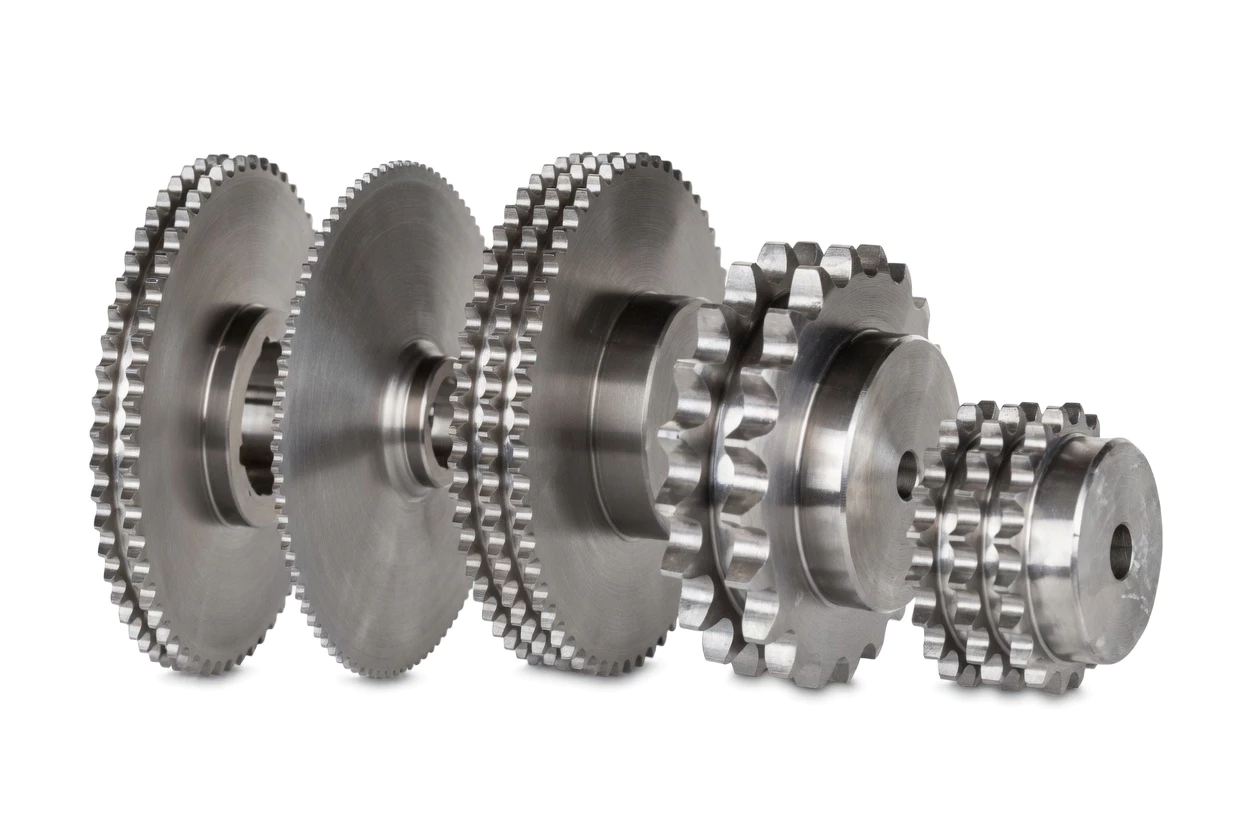
Hay and straw balers — round balers, large square balers (LSB), and small square balers — rely on dozens of chain drives to feed, form, tie, and eject bales. Baler chain sprockets are subjected to one of the most severe duty cycles in agricultural machinery: repeated shock loading from crop pick-up and plunger impact, abrasive chaff and dust, and continuous operation across long baling days. A failed baler sprocket in the field costs valuable baling-weather time. Browse our agricultural sprockets →

Overview
A modern large square baler (LSB) may contain 20–40 individual chain drive positions covering pick-up, pre-cutter, feeder, packer, plunger drive, bale measurement, knotters, and bale ejector functions. Round balers use 10–20 chain drives for the pick-up, rotor, belt drive, bale chamber chain, and wrapping system. All of these operate in a dusty, chaff-laden environment with intermittent heavy shock loading. The most demanding positions — plunger drive, feeder chain, and knotter crank chain — require the highest quality induction-hardened sprockets to survive a full baling season.
技術仕様
| パラメータ | Baler Value | Range |
|---|---|---|
| Chain Standard (pick-up/feeder) | ANSI #50 / #60 | ANSI #40–#80 |
| Chain Standard (plunger drive) | ANSI #80 / #100 | ANSI #60–#120 |
| ピッチ | 15.875–25.4 mm | 12.7–38.1 mm |
| Tooth Count (driver) | 13T – 21T | 9T – 30T |
| Material (standard) | C45 induction-hardened | 40Cr alloy for plunger drive |
| 歯の硬度 | HRC 50~60 | HRC 48–62 |
| ケースの奥行き | 1.5~2.5 mm | Up to 3.5 mm |
| Shock Load Rating | High (plunger cycle) | Very high for plunger drive sprocket |
| ハブスタイル | Type B finished bore | Taper-bushed on plunger and feeder main drives |
| 内径公差 | H7 | H6 for critical alignment positions |
| Surface | Black oxide / zinc | — |
| 海岸線 | Simplex | Duplex on high-power plunger drives (LSB) |
| Lubrication | Manual spray or drip | Per OEM service interval |
| Operating Environment | Dusty, chaff, moisture | Sealed-hub on request for LSB |
| 機械加工グレード | DIN Grade 6 | — |
| 熱変形 | ≤0.05 mm | — |
| Seasonal Life Expectation | 1–3 seasons depending on position | — |
| Documentation | Batch cert on request | — |
| Weight (ANSI #50 Z=17) | ~0.8 kg | 0.2–12 kg |
Performance Advantages
互換性情報
| Baler Position / Chain | Recommended Sprocket | 注記 |
|---|---|---|
| Round baler pick-up drive (ANSI #50) | ANSI #50 C45 induction-hardened sprocket | High shock from crop ingestion |
| Round baler rotor chain (ANSI #60) | ANSI #60 sprocket | Check OEM tooth count carefully |
| LSB feeder chain (ANSI #60) | ANSI #60 sprocket | High cyclic load, replace pre-season |
| LSB plunger drive chain (ANSI #80 / #100) | ANSI #80 / #100 heavy-duty sprocket | 40Cr alloy steel preferred |
| LSB knotter chain (ANSI #40 / #50) | ANSI #40 / #50 precision sprocket | Grade 6 for knotter timing |
| Small square baler plunger (ANSI #50) | ANSI #50 heavy-duty sprocket | Shock load tolerant |
| John Deere, New Holland, Kuhn balers (ref only) | ANSI #40–#100 interchangeable | Verify tooth count per baler service manual |
| CLAAS, Krone, Massey Ferguson (ref only) | ISO 10B–20B or ANSI equivalent | Confirm chain standard (ISO vs ANSI) |
Selection Guide for Baler Sprockets
| 📑 | Service Manual First | The baler service manual is the authoritative reference for every chain drive position: chain part number, pitch, tooth count, bore, and replacement interval. Always start here — baler chain drives are interconnected, and incorrect tooth count on one drive can cause timing and feed rate errors. |
| 🔎 | Inspect All Positions Pre-Season | Inspect every chain drive sprocket before the baling season. Look for: hook-tooth wear pattern, broken teeth, bore fretting, and shaft keyway damage. Any sprocket with >15% tooth height loss should be replaced before baling starts. |
| 💪 | Plunger Drive: Specify Alloy Steel | The plunger drive is the highest-load sprocket position on large square balers. Specify 40Cr alloy steel with case hardening for this position — C45 will wear faster under the cyclic peak torques of LSB plunger drives. |
| 🚚 | Carry Field Spares | For long baling days far from the workshop, carry spare sprockets for the most failure-prone positions: pick-up drive, feeder chain, and knotter chain. A sprocket change in the field takes <30 minutes and avoids a long tow back to the workshop. |
Installation for Baler Sprockets
- Pre-season service: Ideally replace worn sprockets during the annual pre-season service, not in the field during baling.
- Isolate the baler PTO: Disengage PTO, park tractor with brake on, shut engine before any baler chain work.
- Identify the chain position using the baler service manual. Photograph the chain routing before disassembly.
- Open chain at connecting link. For ANSI #50–#80, a chain-break tool is recommended; avoid hammering chain pins through.
- Remove worn sprocket: loosen set-screw and slide off shaft. For plunger drive positions, the drive shaft may need to be moved to the correct rotational position to allow sprocket removal — refer to service manual.
- Install new sprocket: seat key, tighten set-screw to specification, apply thread-lock compound.
- Install new matching chain: close connecting link, orientate clip open end away from direction of travel.
- Tension chain: adjust per baler service manual — typically 10–25 mm deflection at mid-span. Correct tension is critical for knotter chains where slack causes knot failures.
- Test at low PTO speed before engaging full baling speed. Verify all chain positions are running smoothly before the first bale.
Troubleshooting Baler Sprocket Issues
| 症状 | Probable Cause | Recommended Action |
|---|---|---|
| Knot failures (string breaking) | Worn knotter chain sprocket causing timing lag | Replace knotter drive sprocket; verify chain tension |
| Bale ejection failure | Worn ejector chain sprocket | Replace ejector drive sprocket and chain |
| Feeder chain breaking | Worn feeder sprocket causing chain jump at engagement | Replace feeder sprocket and chain simultaneously |
| Plunger drive noise | Worn or damaged plunger drive sprocket | Replace ANSI #80/#100 plunger sprocket |
| Round baler wrap failure | Worn wrap drive chain sprocket | Inspect wrap drive sprocket; replace if hooked teeth |
Australian Customer Case Studies
関連製品:伝動チェーン
⛓️ 互換性のあるトランスミッションチェーン
We manufacture and supply a complete range of ローラー伝動チェーン paired with every sprocket in our catalogue — ANSI, ISO, double-pitch, stainless, and special-purpose chains for every industrial application.
Standards & Certifications
Ever-power Australia製のスプロケットはすべて、以下の国際規格に基づいて製造および試験されています。
Our commitment: 100% dimensional inspection, batch hardness testing, and full traceability on every production run. Material test certificates available on request.

エバーパワー・オーストラリアを選ぶ理由とは?
We are a vertically integrated sprocket manufacturer with 25+ years of chain drive expertise. Our 35,000 m² facility produces 4 million+ sprockets per year to ISO, ANSI, JIS, DIN, BS and GB standards, with ISO 9001 certification on every order. Learn about our manufacturing →
Ready to Order or Need Technical Advice?
Our engineering team is available to recommend the exact sprocket specification for your application. Free selection support, fast quotes, and Australian stock on core sizes.