เฟืองสำหรับสายพานลำเลียงคัดแยกอาหาร
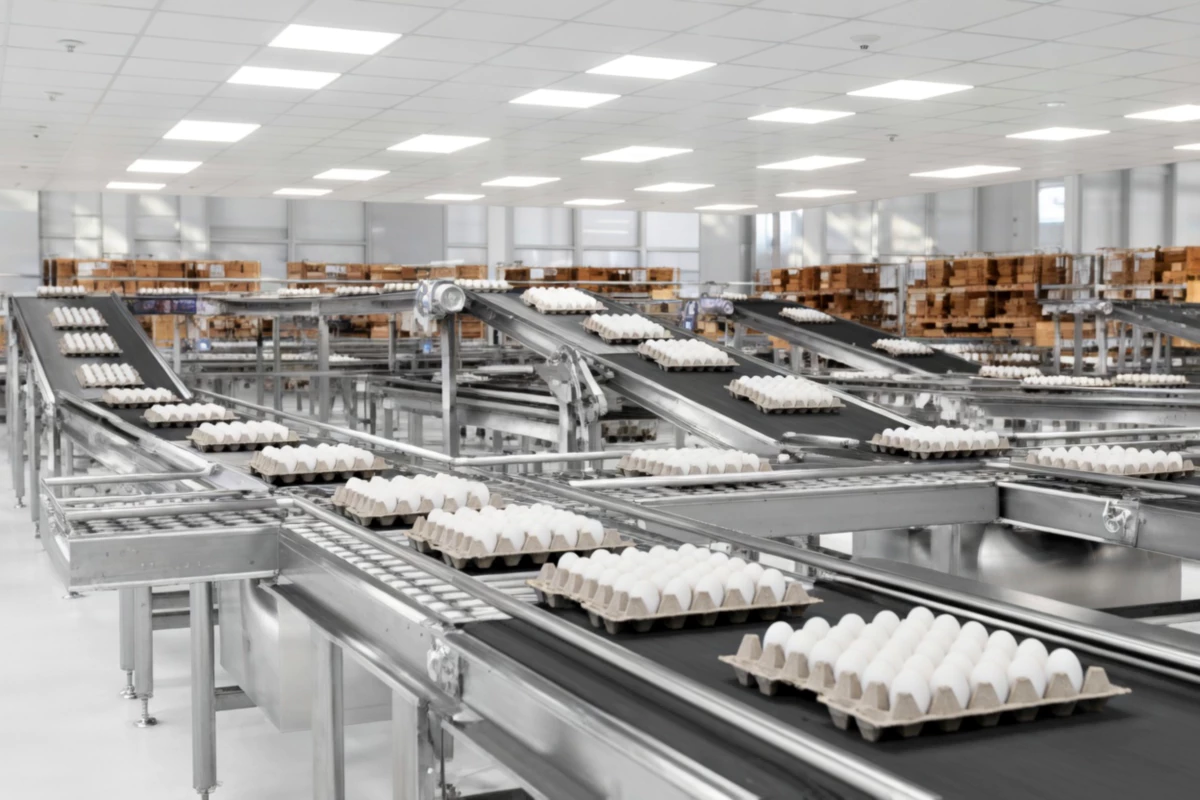
Food sorting and grading conveyors in Australian fresh produce, meat, seafood, and processed food facilities handle open food products at every stage from receival to dispatch. Food sorting conveyor sprockets in these environments must meet the strictest hygiene, cleanability, and material standards — direct or incidental food contact, daily high-pressure washdowns, and compliance with FSANZ, FDA, and HACCP requirements are non-negotiable. Explore our food-grade sprocket range →
Overview
Australian food sorting lines — from apple grading and citrus packing to chicken portioning, prawn grading, and shelf-ready salad production — share common requirements: open-product handling, cold or ambient operating environments, high-pressure washdown with caustic or chlorinated chemicals, and frequent sanitisation cycles. Chain drives convey product through vision-inspection stations, weight graders, optical sorters, and packing stations. Every component must be designed for hygiene, not just bolted on after the fact.
Ever-power Australia supplies SS304 and SS316 stainless steel food sorting conveyor sprockets with polished tooth flanks, drainable hub geometry, and full material certification for FSANZ and HACCP compliance — the components food manufacturers and packers depend on for safe, reliable grading operations.
Technical Specifications
| Parameter |
Food Sorting Value |
Range |
| วัสดุ |
AISI 304 stainless steel |
SS316 for chlorinated sanitisers |
| Chain Standard |
ANSI #35 / #40 / ISO 06B / 08B |
ANSI #25–#50 / ISO 04B–10B |
| Pitch |
9.525 mm / 12.7 mm |
6.35–15.875 mm |
| Surface Finish |
Ra 0.8–1.6 μm polished |
Electropolished Ra <0.4 μm |
| Tooth Hardness (SS304) |
HRB 88–96 |
— |
| Hub Geometry |
Drainable (no horizontal flat surfaces) |
By design to comply with 3-A standards |
| Bore Tolerance |
H7 |
H6 on request |
| Hub Style |
Finished bore or taper-bushed |
Format-changeover: taper-bushed |
| CIP Resistance |
NaOH 2%, NaOCl 200 ppm, HNO3 1% |
SS316 for NaOCl >200 ppm |
| Operating Temperature |
−25°C to +45°C (cold stores) |
Up to 90°C for CIP cycles |
| Washdown Rating |
IP69K hub sealing on request |
— |
| Speed Range |
0.3–2.5 m/s |
— |
| Lubrication |
NSF H1 food-grade oil only |
Dry-film PTFE for no-residue zones |
| Fastener Material |
A4 SS set-screw required |
Prevents galvanic corrosion |
| Machining Grade |
DIN Grade 6 |
— |
| Documentation |
MTC EN 10204 2.2; dim. report |
3-A cert. on request |
| Strand |
Simplex |
Duplex for high-load infeed conveyors |
| FDA Compliance |
21 CFR 177.2600 (SS304) |
— |
| FSANZ Compliance |
Food Contact Regulation 1.5.3 |
— |
Performance Advantages
🍁Drainable Hub DesignOur food sorting sprockets are designed with drainable geometry — no horizontal flat surfaces or crevices where water, product residue, or cleaning chemicals can accumulate. This is a fundamental requirement of 3-A Sanitary Standards and EHEDG hygiene design guidelines for food-contact conveyor components.
🔌Full CIP Cycle ResistanceSS304 withstands standard CIP protocols (NaOH 2%, 80°C; HNO3 0.5%, 50°C; hot water rinse 85°C) without pitting, staining, or dimensional change — maintaining food safety across the sprocket’s full service life.
✨Polished Surface HygieneRa 0.8–1.6 μm polished tooth flanks and hub surfaces reduce product adhesion and microbial biofilm formation — critical for fresh produce and protein-handling lines where food safety is audited by retailer and regulatory inspectors.
🧩Cold-Store CompatibleOur SS304 stainless sprockets operate at temperatures down to −25°C without embrittlement — suitable for frozen food, chilled produce, and cold-store sorting conveyor applications where carbon-steel components may suffer low-temperature corrosion.
📏Format-Changeover SpeedTaper-bushed versions allow rapid sprocket replacement when changing grading formats or belt widths — critical for multi-product packing facilities where downtime during product changeover directly impacts facility profitability.
📚Complete Compliance DocumentationEN 10204 2.2 material test certificates, dimensional inspection reports, and FDA/FSANZ compliance declarations are available with every food sorting sprocket order — meeting the documentation requirements of HACCP, SQF, and BRC certification programmes.
Compatibility Information
| Application / Chain |
Recommended Sprocket |
Notes |
| Fruit & vegetable grading (ANSI #35) |
ANSI #35 SS304 sprocket |
Standard for most AU fruit packing lines |
| Meat portioning conveyor (ANSI #40) |
ANSI #40 SS316 sprocket |
Chlorinated CIP in abattoir environment |
| Seafood grading (ANSI #35 / ISO 06B) |
ANSI #35 or ISO 06B SS316 sprocket |
High chloride brine environment → SS316 |
| Egg washing & grading conveyor (ANSI #35) |
ANSI #35 SS304 sprocket |
High-humidity washdown environment |
| Poultry processing line (ANSI #40) |
ANSI #40 SS316 sprocket |
Heavy caustic & chlorinated CIP |
| Produce washing & inspection (ISO 06B) |
ISO 06B SS304 sprocket |
European OEM grading equipment |
| TOMRA, Key Technology optical sorter (ref only) |
ANSI #35 / #40 interchangeable |
Brand reference; confirm chain pitch |
| Marel, MAJA portioning conveyor (ref only) |
ANSI #40 / ISO 08B SS316 |
Brand reference; verify tooth count |
Selection Guide
🍁
Define Hygiene ZoneProduct-contact zone (direct food contact): SS304 minimum, SS316 for high-chloride environments. Non-contact enclosed drives: C45 carbon steel with dacromet. Always confirm zone classification with your HACCP plan.
📏
CIP Chemical CompatibilityStandard NaOH/HNO3 CIP: SS304. Hypochlorite (NaOCl) sanitiser >200 ppm: SS316. Brine or seawater environments: SS316. Acid phosphoric CIP: SS316. When in doubt, specify SS316 — the cost difference is modest compared to the risk of pitting corrosion.
📈
Speed & LoadMost food sorting conveyors operate at 0.5–2.0 m/s at light-to-moderate load — ANSI #35 or #40 in simplex is appropriate. For high-load infeed conveyors (bulk fruit or root vegetable receival), ANSI #50 or ISO 10B may be required. Confirm with our team.
🔧
Hub Style for ChangeoverMulti-product facilities requiring frequent product changeovers: taper-bushed (QD) stainless sprockets. Single-format lines: finished bore SS304/316 is simpler and lower cost. Specify A4 stainless set-screws on all food-zone sprocket orders.
Installation for Food Sorting Conveyor Sprockets
- Schedule during a planned CIP or sanitation window. Notify QA management before any mechanical changes to food-contact conveyor systems.
- Isolate all drives using LOTO procedure. Food facility LOTO often includes multiple energy sources — pneumatic, hydraulic, and electrical. Verify all are isolated.
- Pre-clean the sprocket zone to food-safe standard before disassembly — do not introduce contamination from an uncleaned drive area into an open-product zone.
- Remove old sprocket using A4 stainless tools. Do not use carbon-steel grinders, wire brushes, or tools that shed particles into the food zone.
- Clean shaft with approved food-equipment solvent. Inspect shaft for pitting, corrosion, or keyway damage.
- Install new SS304/316 sprocket. Use A4 stainless set-screw and apply food-safe thread-lock compound (Loctite 243 NSF-rated).
- Align with mating sprocket to ≤0.3 mm lateral offset. Verify with dial indicator if tight-tolerance grading equipment is involved.
- Lubricate with NSF H1 food-grade chain oil before restarting. Do not use standard mineral oil in open-product zones.
- CIP cycle before food production: Run the conveyor through a CIP cycle and visual food-safety inspection before the first food product is introduced after maintenance.
- Update HACCP records — record the maintenance action, component used, material certificate reference, and sign-off by a qualified person.
Troubleshooting Food Sorting Sprockets
| Symptom |
Probable Cause |
Recommended Action |
| Pitting corrosion on sprocket surface |
SS304 in high-chloride CIP zone |
Replace with SS316; verify CIP protocol concentration |
| Product contamination event (rust particles) |
Carbon-steel sprocket in food-contact zone |
Replace with SS304/316; conduct HACCP review |
| Grade accuracy drift on sorting conveyor |
Worn sprocket increasing chain pitch variation |
Replace sprocket; verify with Grade 6 CMM report |
| Chain derailment during high-speed grading |
Misalignment >0.5 mm |
Realign sprockets to ≤0.3 mm |
| Biofilm formation on sprocket surface |
Ra >1.6 μm surface after wear |
Replace with new polished sprocket; review CIP frequency |
Australian Customer Case Studies
Julie W. — Swan Hill, VIC★★★★★Engineering Manager, Fruit Packing Shed
“We upgraded our entire stone-fruit grading line to SS304 stainless sprockets from Ever-power after failing a retailer hygiene audit on our previous carbon-steel components. The polished su
“Our chlorinated CIP protocol required SS316 sprockets in the poultry processing conveyor zone. Ever-power supplied SS316 with material certificates as standard. The sprockets have survived 14 months of aggressive chlorine CIP without any pitting. Very impressed.”
March 2025
Brian N. — Fremantle, WA★★★★★Maintenance Engineer, Seafood Processor
“Marine/brine environment plus CIP — a brutal combination for any metal component. SS316 stainless sprockets from Ever-power have lasted 22 months on our prawn grading line without corrosion or significant wear. These are now our standard specification for all seafood processing conveyor drives.”
January 2025
Penny K. — Renmark, SA★★★★★Quality & Engineering Manager, Fresh Produce Packer
“SQF Level 2 certification requires all maintenance components in food-contact zones to have material compliance documentation. Ever-power provides this as standard with their stainless sprockets — it simplifies our supplier qualification process significantly. Excellent product and documentation standard.”
March 2025
Frequently Asked Questions
+ Do all food sorting conveyor sprockets need to be stainless steel?
Only sprockets in the food-contact or product-adjacent zone (where the sprocket is directly above open product, subject to splash, or within the CIP washdown zone) must be stainless steel. Sprockets in enclosed drive areas, behind sealed guards with no food-contact risk, can be carbon steel with appropriate coating. Classify each position against your HACCP food safety plan.
+ What is the difference between SS304 and SS316 for food sorting applications?
SS304 is appropriate for standard NaOH and HNO3 CIP protocols and low-chloride environments. SS316 (with 2% molybdenum) is required for high-chloride environments including hypochlorite (bleach) sanitisers above 200 ppm, brine or salt solutions, and marine or seafood processing environments where chloride pitting corrosion is a risk.
+ What surface finish is required for food-contact sprockets?
EHEDG and 3-A Sanitary Standards recommend a maximum Ra of 0.8 μm for food-contact surfaces. Our standard food sorting sprockets are polished to Ra 0.8–1.6 μm. For pharmaceutical or ultra-hygienic food applications, electropolished Ra <0.4 μm is available on request.
+ Can I use NSF H2 lubricant on food sorting conveyor chains?
No. NSF H2 lubricants are approved for use only where there is no possibility of food contact. For food-contact and product-adjacent zone chain drives, NSF H1 lubricant (incidental food contact approved) is mandatory. Many facilities use dry-film PTFE lubricant to eliminate any liquid lubricant residue risk entirely.
+ How do I comply with HACCP requirements for sprocket replacement?
Your HACCP plan should specify: (1) material requirements for food-contact zone components (SS304 minimum), (2) approval process for maintenance materials (material certificates required), (3) post-maintenance CIP protocol before food production, and (4) maintenance record with component reference and sign-off. Our material test certificates and food-compliance declarations satisfy all these requirements.
+ Do you supply sprockets with IP69K sealing for high-pressure washdown?
Yes. We can supply food-sorting sprockets with IP69K-rated sealed hub assemblies for high-pressure washdown applications (80 bar, 80°C, direct spray). This is particularly valuable for poultry and meat processing conveyor drives where high-pressure washdown is part of the daily sanitation protocol. Contact us for IP69K sealed hub specifications.
+ What causes premature wear on food sorting stainless sprockets?
SS304 tooth hardness (HRB 90–96) is lower than induction-hardened C45 (HRC 50–60), so abrasive products (root vegetables with soil, shellfish with shell fragments) will wear SS304 teeth faster than carbon steel. For abrasive-product sorting conveyors, consider hard-chrome-faced SS316 or contact our team for application-specific recommendations.
+ Can food sorting sprockets be repaired if a tooth is damaged?
No. Stainless steel sprocket teeth cannot be repaired economically once damaged. Any sprocket with a broken, severely worn, or pitted tooth in the food-contact zone must be replaced immediately — damaged tooth surface is a food-safety risk (metal fragment contamination). Keep a replacement sprocket in food-safety-accessible spare-parts stock.
+ Do you supply complete food sorting conveyor drive sets?
Yes. For facility upgrade or new build projects, we can supply complete food-sorting conveyor sprocket sets, including head and tail drive sprockets, idler/tensioner sprockets, and matching stainless chain lengths. Provide the machine specification and we will quote a complete food-grade drive train set with full compliance documentation.
+ What is the minimum order for SS304 food sorting sprockets?
No minimum order on standard ANSI #35 and #40 SS304 stainless sprockets in common tooth counts — single-piece urgent replacement orders are accepted. For SS316, ISO stainless, or custom bore stainless sprockets, MOQ is typically 5 pieces with 2–4 week lead time. Contact us for exact availability.
Related Products: Transmission Chains
⛓️ Compatible Transmission Chains
We manufacture and supply a complete range of roller transmission chains paired with every sprocket in our catalogue — ANSI, ISO, double-pitch, stainless, and special-purpose chains for every industrial application.
View Chains →
Standards & Certifications
All Ever-power Australia sprockets are manufactured and tested to the following international standards:
✓ ISO 9001:2015✓ ANSI B29.1✓ ISO 606✓ DIN 8187✓ JIS B 1801✓ BS Standards
Our commitment: 100% dimensional inspection, batch hardness testing, and full traceability on every production run. Material test certificates available on request.

Why Choose Ever-power Australia?
We are a vertically integrated sprocket manufacturer with 25+ years of chain drive expertise. Our 35,000 m² facility produces 4 million+ sprockets per year to ISO, ANSI, JIS, DIN, BS and GB standards, with ISO 9001 certification on every order. Learn about our manufacturing →
ISO 90014M+ pcs/yearOEM CapableAU Stock
Ready to Order or Need Technical Advice?
Our engineering team is available to recommend the exact sprocket specification for your application. Free selection support, fast quotes, and Australian stock on core sizes.
📩 Get a Free Quote 🔍 Browse Products