Sprockets for Automated Production Equipment
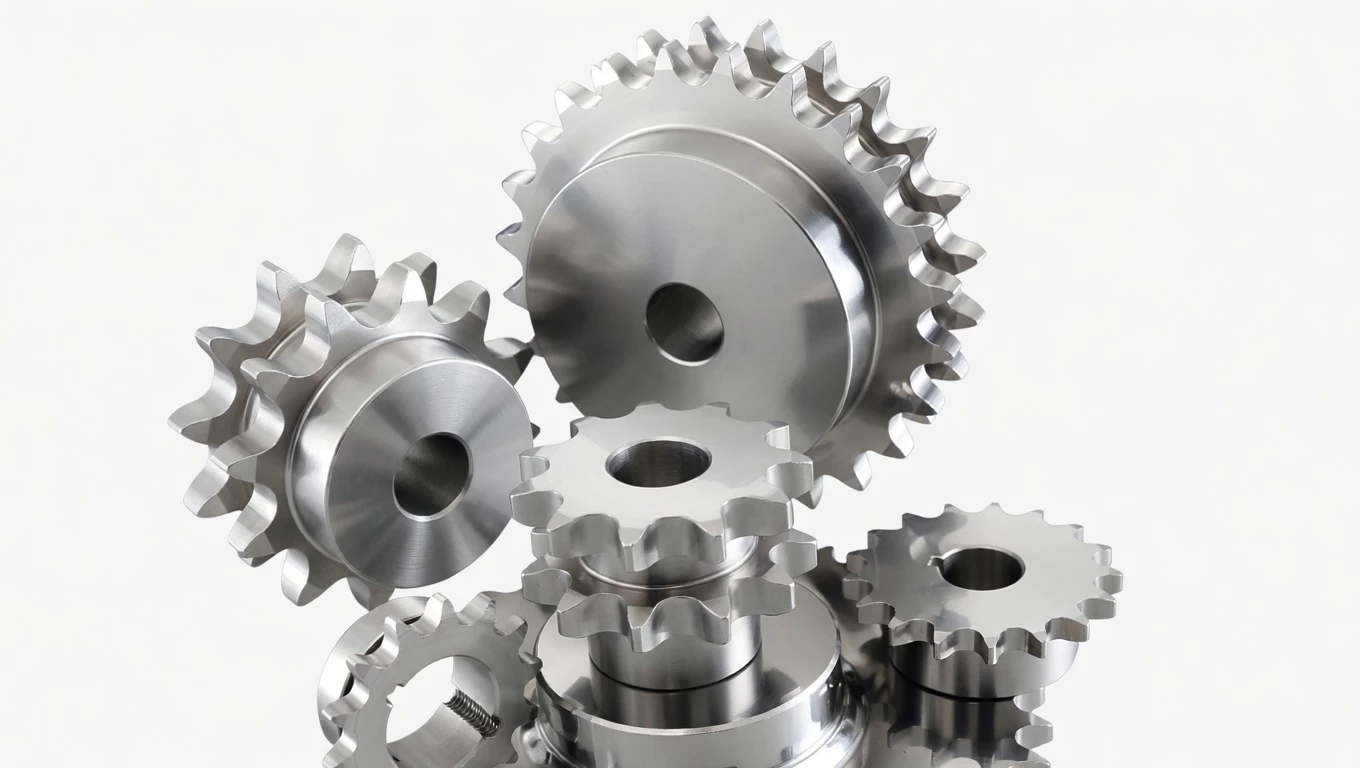
Automated production equipment — CNC machining cells, robotic transfer systems, automated storage and retrieval systems (ASRS), and servo-driven positioning lines — demands precision sprockets capable of operating at high cycle rates with minimal backlash, consistent pitch engagement, and long service intervals. In automated systems, a failing sprocket does not just cause downtime — it can trigger machine faults, positional errors, or safety shutdowns across the entire cell. Explore our precision sprocket range for automation applications.
Gambaran Keseluruhan
In automated manufacturing environments, roller chain drives are used where the torque capacity, flexibility of routing, and resilience of chain drives outperform timing belts or rack-and-pinion systems. Key applications include:
• Servo-driven transfer and indexing conveyors
• Automated guided vehicle (AGV) drive systems
• ASRS crane and aisle-transfer drive chains
• Robot transfer unit (RTU) linear drives
• CNC gantry and tool-change magazine drives
In each case, the sprocket must deliver precision pitch engagement (Grade 6 or better), consistent backlash across the full tooth range, and long life under high-cycle, often-unlubricated or minimally lubricated conditions.
Spesifikasi Teknikal
| Parameter | Automation Value | Customisable Range |
|---|---|---|
| Chain Standard | ANSI #40 / ISO 08B-1 | ANSI #25–#60 / ISO 04B–12B |
| Pitch | 12.7 mm | 4.76–19.05 mm |
| Gred Pemesinan | DIN Gred 6 | Grade 5 (ultra-precision on request) |
| Ketepatan Pitch | ±0.005 mm | ±0.003 mm (Gred 5) |
| Backlash (per tooth pair) | ≤0.08 mm | ≤0.05 mm (premium grade) |
| Kekerasan Gigi | HRC 52–60 | HRC 48–62 |
| Thermal Deformation | ≤0.05 mm post-HT | â |
| Toleransi Lubang | H7 | H6, H5 (servo-direct applications) |
| Keyway | DIN 6885 / involute spline | Custom spline, polygon bore |
| Larian Habis (TIR) | ≤0.05 mm | ≤0.025 mm (precision) |
| Bahan | C45 / 40Cr alloy steel | SS304, aluminium alloy, engineering plastic |
| Gaya Hab | Finished bore, taper-bushed | Flanged hub, servo flange mount |
| Permukaan | Black oxide / zinc | Nickel plate, hard anodise (alloy) |
| Max Cycle Rate | Up to 120 cycles/min | Application-specific |
| Operating Temperature | −20°C to +100°C | Up to +180°C (alloy) |
| Strand | Simpleks | Duplex for servo-balancing |
| Balance | Static balance standard | Dynamic balance on request |
| Dokumentasi | Dimensional report | CMM report with all tooth data |
| MOQ (standard) | 10 pieces | 1 piece prototype available |
Key Performance Advantages
Working Principle in Automated Equipment
In a servo-driven indexing conveyor or robot transfer unit, the motor drives a primary sprocket on the servo gearbox output. The chain transmits motion to a driven sprocket on the transfer axis, moving the workpiece carrier or tool-change magazine a precise distance per motor revolution. The sprocket tooth count ratio, combined with the servo encoder feedback, determines positional accuracy.
Any variation in sprocket tooth pitch, profile error, or backlash directly manifests as position error at the workpiece — critical in tight-tolerance assembly or inspection stations. This is why automation engineers specify Grade 6 or Grade 5 precision sprockets, and why our CMM-verified production process is particularly valued by automation system integrators.

Maklumat Keserasian
| System / Chain | Sproket yang Disyorkan | Nota |
|---|---|---|
| ANSI #40 servo index chain | ANSI #40 Grade 6 sprocket | Standard for Australian automation integrators |
| ISO 08B-1 chain | ISO 08B-1 sprocket | European PLC/drive systems |
| ASRS stacker crane drive | ANSI #60 / ISO 12B sprocket | Higher load, lower speed |
| AGV drive chain | ANSI #35 / ISO 06B sprocket | Compact, lightweight requirement |
| Fanuc, Yaskawa RTU drive | ANSI #40 taper-bushed sprocket | Brand reference only, not affiliated |
| Siemens / SEW servo gearbox output | Finished bore H6/H7 sprocket | Match bore to gearbox output precisely |
| STIEBEL, Neugart planetary gearbox | Taper-bushed or precision bore sprocket | Grade 6 minimum for backlash-sensitive apps |
Selection Guide for Automation Engineers
Installation for Automated Systems
- De-energise and lock out all drives. On servo systems, disable the servo amplifier and confirm brake engagement.
- Record datum position of the automated system before disassembly if index position must be restored after maintenance.
- Remove chain and old sprocket carefully. Photograph chain routing and mark sprocket orientation relative to drive shaft.
- Clean shaft, verify dimensions. Use a bore gauge to confirm shaft diameter vs. new sprocket bore. TIR ≤0.02 mm on shaft is recommended for precision applications.
- Install new sprocket with precision arbor press if H6 fit is specified. Apply thread-lock to set-screw; torque to specification.
- Align mating sprockets with laser alignment tool — target angular ≤0.2° and lateral ≤0.2 mm for precision automation. Verify with dial indicator on chain flight.
- Install chain, set tension. Sag 1.5–2% of centre distance. On servo index drives, verify chain tension uniformity around the full stroke.
- Restore datum position and jog the system through 5 complete cycles before returning to auto mode. Verify positional accuracy against specification.
Troubleshooting Automated System Sprocket Issues
| Fault | Cause | Action |
|---|---|---|
| Position error on index axis | Worn teeth increasing backlash | Replace sprocket; verify chain elongation |
| Servo over-torque alarm | Chain tension too high or misalignment | Reduce chain tension; realign sprockets |
| Velocity ripple at low speed | Chordal action from insufficient teeth | Use T_driver ≥17; consider smaller pitch |
| Sprocket walking on shaft | Loose bore fit or insufficient set-screw | Apply Loctite 638; upgrade to H6 bore fit |
| Chain derailment at high speed | Worn or damaged sprocket teeth | Immediate replacement; add chain guides |
| CMM position drift over time | Progressive chain elongation | Replace chain at 2% elongation limit |
Case Studies — Australian Automation
Soalan Lazim
Produk Berkaitan: Rantai Transmisi

⛓️ Rantai Transmisi yang Serasi
We also manufacture and supply the complete range of rantai penghantaran roller to pair with every sprocket in our catalogue — ANSI, ISO, double-pitch, stainless, and special-purpose chains for all industrial applications.
Certifications & Standards
All Ever-power Australia sprockets are manufactured and tested to the following international standards:
Komitmen kualiti: 100% dimensional inspection, hardness verification, and batch traceability on every production run. Material test certificates (EN 10204 2.2) available on request.

Mengapa Memilih Ever-power Australia?
We are a vertically integrated sprocket manufacturer with 25+ years of chain drive expertise. Our 35,000 m² facility produces 4 million+ sprockets per year to GB, ISO, ANSI, JIS, DIN and BS standards. We supply OEM partners, distributors, and direct industrial buyers across Australia with ISO 9001 certified quality on every order. Learn about our manufacturing capability →
4M+ pcs/year
Mampu OEM
AU Stock Available
Ready to Optimise Your Drive System?
Ever-power Australia’s engineering team is available to recommend the right sprocket for your specific application. Request a free quote or technical consultation today.