Technical Specifications — Idler & Tensioner Sprockets
| المعلمة |
قيمة |
ملحوظات |
| Chain Compatibility |
ISO 06B – 20B, ANSI #35 – #80 |
Per model |
| Mounting |
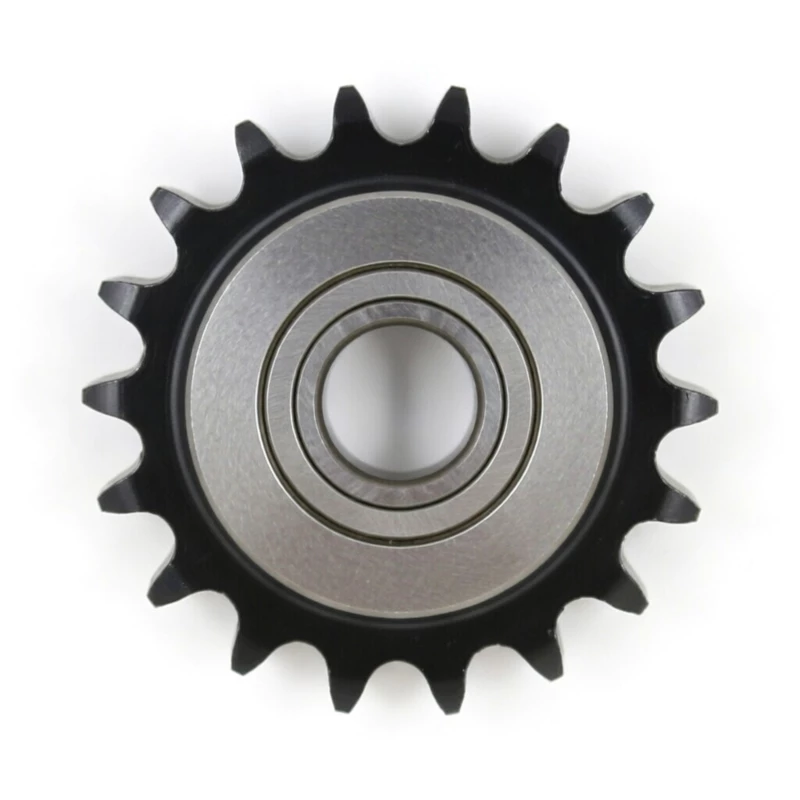
Bearing bore (pre-loaded bearing) |
|
| Bearing Type |
Deep-groove ball bearing |
SKF/NSK equivalent |
| نمط المحور |
Plain bore with bearing seat |
|
| مادة |
فولاذ كربوني C45 |
خيار SS304 |
| صلابة الأسنان |
HRC 45–55 |
Moderate (idler loading) |
| Sealing |
Sealed bearing (2Z or 2RS) |
|
| Max Speed |
800 – 1500 rpm |
Chain-dependent |
| معيار |
ISO 606 / ANSI B29.1 |
|
Key Features
Precision Bearing Integration
Pre-mounted sealed deep-groove ball bearings (2Z or 2RS type) provide smooth, maintenance-reduced free rotation with rated dynamic load capacity to match chain pull forces.
Chain Sag Elimination
Correctly positioned idler sprockets eliminate chain sag on long centre distances, preventing chain derailment, fatigue failures, and the noise associated with loose-chain operation.
Wrap-Angle Optimisation
Adding an idler increases chain wrap angle on small driving sprockets — critical in drives where the ratio exceeds 3:1 or where physical constraints limit centre distance.
️
Corrosion-Resistant Option
SS304 stainless idler sprockets available for food-processing and marine environments where exposure to water, salt, or cleaning agents is continuous.
Compatibility & Selection
Idler sprockets are available for ISO chain sizes 06B through 20B and ANSI sizes #35 through #80. Specify chain size, required shaft or bearing diameter, and mounting configuration (fixed shaft, adjustable bracket, or spring-loaded) when ordering. Contact our engineers for a drive layout assessment and idler specification recommendation.
التطبيقات

Agricultural Drives
Multi-sprocket harvester and combine drives requiring chain guidance over long runs

Conveyor Returns
Chain return-strand guidance and tensioning in long conveyor systems

Construction Equipment
Wrap-angle increasing idlers on crawler-track and hoisting drives

⛏️ Mining Conveyors
Tensioning sprockets on underground conveyor chain drives
آراء العملاء
Phil A.
★★★★★
أستراليا
“Fitted bearing-mounted idler sprockets to our grain-elevator drive — eliminated the chain sag that was causing jump-start failures at harvest time. Excellent product.”
Idler Sprocket ISO 10B-1 · March 2025
Nathalie V.
★★★★★
France
“The bearing quality is excellent — ran at 600 rpm for 2000 hours with no heating or noise. Will specify these on all future drive designs.”
Idler Sprocket ISO 08B-1 Z=17 · February 2025
Mike T.
★★★★☆
Canada
“Good product. Minor surface finish variation across units but dimensionally consistent and functionally flawless.”
Idler Sprocket ANSI #50 Z=21 · January 2025
Sanjay P.
★★★★★
India
“Stainless idler sprockets for our food conveyor have survived 18 months of daily caustic wash without bearing failure — impressed.”
SS304 Idler ISO 06B-1 · April 2025
التعليمات
► How do I size an idler sprocket for my drive?
The idler sprocket must match the chain pitch exactly. Tooth count is typically 17–25T for idlers. The bearing bore should suit your shaft or mounting spindle diameter. Contact our engineers for a full sizing recommendation.
► Should the idler sprocket be on the tight or slack side?
Idlers are almost always fitted on the slack (return) strand where chain tension is lowest — this reduces bearing loads and extends life. Tight-side idlers are only used when geometry demands it and should be specified with heavier-duty bearings.
► How often should I replace the idler bearing?
Sealed bearing life under normal load is typically 8,000–15,000 hours. Replace when you detect noise, heating, or roughness in the bearing. Many customers replace idler sprockets as an assembly with the scheduled drive chain replacement.
► Can I adjust the idler position after installation?
Yes, if you use our adjustable-bracket idler mount option. Fixed-shaft idlers are set at installation — specify your required chain-line and centre distance to ensure correct positioning.
► Are stainless steel idler sprockets available for all sizes?
SS304 idler sprockets are available for ISO 06B through 16B. For other sizes or stainless bearing options, contact our sales team for lead time and pricing.
- Determine the chain sag or wrap-angle deficiency that the idler will correct — calculate required idler position.
- Mount the idler sprocket on a fixed or adjustable shaft bracket; ensure the bearing bore is a clean fit on the shaft.
- Align the idler tooth plane with the chain-line within 0.5 mm to prevent lateral chain loading on the bearing.
- Set slack-strand tension: the idler should eliminate sag but not over-tension the chain.
- Check bearing temperature after initial run: normal is less than 40°C above ambient. Investigate if higher.
✓ ISO 9001:2015✓ ANSI B29.1✓ ISO/DIN 8187✓ JIS B 1801✓ معايير BS/DIN✓ معايير بريطانيا العظمى

لماذا تختار شركة إيفر باور أستراليا؟
نحن شركة تصنيع متكاملة رأسياً، نمتلك خبرة تزيد عن 25 عاماً في مجال أنظمة نقل الحركة بالسلاسل. يمتد مصنعنا على مساحة 35,000 متر مربع، وينتج أكثر من 4 ملايين ترس سنوياً. نوفر منتجاتنا لشركاء تصنيع المعدات الأصلية والموزعين والمشترين الصناعيين المباشرين في جميع أنحاء أستراليا، وهي مطابقة لمعايير GB وISO وANSI وJIS وDIN وBS.
حاصل على شهادة ISO 9001
أكثر من 4 ملايين قطعة/سنة
قادر على تصنيع المعدات الأصلية
متوفر في أستراليا
هل أنت مستعد للطلب؟ احصل على عرض سعر مجاني اليوم
يتوفر فريقنا الهندسي على مدار الساعة طوال أيام الأسبوع للمساعدة في المواصفات والتصميمات المخصصة وتسعير الكميات للشركات الأسترالية.
📩 اطلب عرض سعر
🔍 تصفح جميع المنتجات